
Quarantine, Coronavirus, and the Constitution
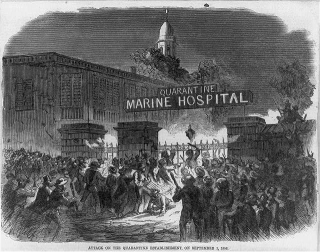
Eugene Volokh over at the Volokh Conspiracy recently posted a blog sharing the expertise of law professor and M.P.H. Ed Richards on the issue of the constitution and coronavirus quarantine measures. Professor Richards notes that drastic public health measures were the rule of the day during our republic’s early years, and that there is a strong originalist argument in favor of public health concerns trumping certain individual constitutional concerns.
As Richards noted:
Colonial boards of health may have been the first administrative agencies in the US. They exercised Draconian powers that were rooted in English law. The English statutory and common law recognized the right of the state to quarantine and limit the movement of plague carriers. Blackstone observed that disobeying quarantine orders merited severe punishments, including death. The argument of counsel in Smith v. Turner, 48 U.S. 283, 340-41 (1849) described measures to control a yellow fever outbreak in Philadelphia:
For ten years prior, the yellow-fever had raged almost annually in the city, and annual laws were passed to resist it. The wit of man was exhausted, but in vain. Never did the pestilence rage more violently than in the summer of 1798. The State was in despair. The rising hopes of the metropolis began to fade. The opinion was gaining ground, that the cause of this annual disease was indigenous, and that all precautions against its importation were useless. But the leading spirits of that day were unwilling to give up the city without a final desperate effort. The havoc in the summer of 1798 is represented as terrific. The whole country was roused. A cordon sanitaire was thrown around the city. Governor Mifflin of Pennsylvania proclaimed a non- intercourse between New York and Philadelphia.
These powers are classic police powers, exercised by the states. While they were not at direct issue in Smith, the power to quarantine ships was upheld against commerce clause and foreign affairs challenges in Morgan’s Steamship Co. v. Louisiana Board of Health (1886). The power to establish cordons sanitaire was upheld in Compagnie Francaise de Navigation a Vapeur v. Board of Health of State of Louisiana (1902). The right of the state to require vaccination was upheld in Jacobson v. Massachusetts (1905).
As Richards goes on to comment, while the breadth of power the government can exercise is broad, it must be exercised with wisdom. The yellow-fever quarantine, for instance, we now know to be counterproductive: the disease is spread by mosquitoes, and quarantine only kept people in harm’s way.
Most governmental limitations on gatherings and the imposition of involuntary quarantine have been, and likely will continue to be, local. The federal government’s power to quarantine comes primarily from the Commerce Clause, as well as a statute passed pursuant to the power granted by that clause, 42 U.S.C. § 264. This statute is restricted to the quarantine of people at a certain stage of infection who either cross state lines, or are likely to come into contact with those who will cross state lines.
Local and state governments, however, have no such restrictions on their police power over local conditions regarding health and safety. For a listing of each state’s statutory power to quarantine, see this website. As you can see, each state takes a different approach and violations carry different penalties, all of which may be tested under both state and federal constitutional challenges.
Due process challenges may be raised, as they have in the past, in response to the deprivation of liberty interests. Exactly what standard would be applied to these challenges is an interesting question. In Addington v. Texas, 441 U.S. 418 (1979), the Supreme Court dealt with an analogous issue – the involuntary confinement of persons with mental illness to state asylums. Noting that “[t]his Court repeatedly has recognized that civil commitment for any purpose constitutes a significant deprivation of liberty that requires due process protection,” the court went on to discuss what standard was necessary in such cases. Id. at 425.
In order to protect competing interests of the State and its wards, the Supreme Court concluded that something more than “preponderance of the evidence” was necessary, but that the “reasonable doubt” standard used in criminal cases was too high. The Court thus held that a “clear and convincing standard” was the constitutional floor for commitment cases. See Id. at 430-33.
It is not entirely clear that the Addington standard would apply to infectious disease quarantine. There would be an argument for a lower standard, given the urgent and emergent nature of the current situation as compared to the usually measured and individual determination of mental illness. But Addington does give those who are curious some reading into the balancing interests at issue in crafting that standard.
Under Addington and other authorities, what must be proven by this “clear and convincing evidence” is not just that the person to be confined was mentally ill, but also that they presented a threat to themselves and others. It is likely that similar proof would be required for quarantine – that the person has been exposed to the virus, and that they present a risk to themselves or others if not confined. See Michael R. Ulrich, et al., Quarantine and the Federal Role in Epidemics, 71 SMU L. Rev. 391 (2018).
This analysis not purely academic. Some of those under voluntary quarantine have already broken their confinement and been placed into involuntary quarantine. More will likely have to be place there. And if conditions continue to deteriorate, the full extent of the federal governments power under 42 U.S.C. § 264 may be tested.
Hopefully, the “curve will flatten” soon thanks to voluntary compliance. If not, local and federal governments have powerful tools available to intercede, limited only by constitutional principles with application that is currently ill-defined.
(image attribution: Attack on the Quarantine establishment [Staten Island, N.Y.] on September 1, 1858, appearing in Harper’s Weekly, Sept. 11, 1858).