
More Two-Minute Thoughts
A couple of weeks ago Kent Streseman posted a blog about the Supreme Court’s new “two minute rule,” generally allowing the first two minutes of oral argument to proceed without questioning, and how it had been applied in the first couple of oral arguments after its introduction. As he noted, the writers of this blog are watching with interest to see how it is applied and what, if any, difference it makes in oral argument.
Of course, we all have our opinions as to the value of this time and how it should be used. As I ponder the best use, a couple of theories are bouncing around in my head that suggest possible strategies.
First, there is the narrative paradigm. Walter Fisher, a communications theorist, suggested this paradigm in the 70s, and it has continued to have influence since then. Basically, Fisher suggested that the objective notions of rhetoric may be less important than the subjective importance of the story being told to the listener. So long as the story is internally coherent and truthful to the listener’s own notions, then the listener will have “good reasons” to believe the story, whether those reasons are objectively true or not.
As legal practitioners, we tend to shy away from the narrative paradigm. Instead, we tend to couch our “storytelling” in terms of Aristotle’s pathos – one of his triad of support for a good argument that involves the appeal to our audience’s emotion. But the narrative paradigm goes deeper than this. It suggests that there are “truthy” arguments that appeal to us as storytellers that are more influential than just an appeal to either logic or emotion.
The second theory in some ways justifies Fisher’s paradigm with neuroscience. As we have written before on this blog, neuroscience supports the ideal that there is “fast” and “slow” thinking processes at work in all of us. The “fast” processes rely on surface thinking that is informed by often unconscious preconceptions, stereotypes, and biases. It takes little thought to avoid the snarling dog, drive a well-known route, or even read the average blog. Unfortunately, it also takes little thought to dismiss the arguments made by someone against whom the judge has an implicit bias, or rule in a way that is consistent with prior rulings, even though circumstances may have changed. It is important, then, to engage the “slow,” deliberate thinking of a panel by exposing implicit bias where necessary.
These two concepts – the importance of storytelling and the dangers of implicit bias – suggest different approaches in different cases. It may be important in your case to unveil potential implicit bias and deal with it explicitly at the start in order to quickly engage deliberative thinking. It may also be important in your case to reframe the story that underlies the facts so that the panel does not lose track of the human story that underlies the legal issue. The two minute rule gives you time to address these issues when they arise.
There are many other strategic uses of the two minute rule. Whatever your thought process, just remember that this time is valuable, and should be used more deliberately than just a time set-aside for a statement of theme and introduction of a roadmap.
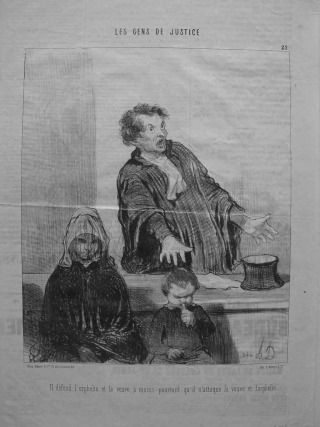
(Image credit: Honore Daumier, “He defends the widows and orphans, unless he is attacking widows and orphans,” 1846 lithograph from the series “Le Gens de Justice.”)