
Moral Foundation Theory as the Basis for Legal Argument Themes
During the second semester of 1L year, many law school curriculums dive into persuasive writing and oral advocacy. This is the first time students are introduced to themes, and beyond presenting an objective evaluation of a hypothetical problem, they are asked to find the “right” solution. This is beyond what the precedent may call for, this is advocating on behalf of a client for the most “just” outcome. This is getting closer to Real World law practice (or cynics could say, Ideal World law practice).
As lawyers we are familiar with all kinds of legal arguments: rule based arguments, analogies and distinctions, inductive reasoning, and policy arguments. Since most moot court problems usually end up based in a fictitious Supreme Court, many arguments frequently come down to policy: “The Supreme Court can do whatever it wants – what should it do?” In introducing these various types of policy arguments to students, certain definitive ideas come to mind like government overreach, privacy, and even economy and efficiency. These ideas seem to have no overarching theme; they sort of have to be dreamt up by the students or gleaned from dicta. However, there may be a more predictable way to organize these disparate ideas and it might be found in something psychologists call Moral Foundation Theory.
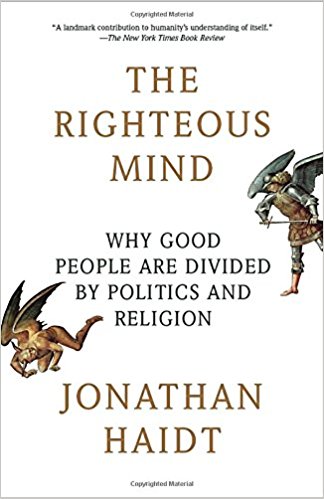
In his book, The Righteous Mind, Jonathan Haidt, a research psychologist, has examined the origins of morality. He takes a science based, and in fact Darwinian based, approach to determining where morals come from and how they persist throughout myriad societies. His research is fascinating, but for our purposes none more so in how this theory can be applied to legal argument.
Haidt has found that across societies there are six general moral foundations: Care/Harm, Fairness/Cheating, Authority/Subversion, Sanctity/Degradation, Loyalty/Betrayal, and Liberty/Oppression. Each pair listed shows the positive side of the moral, and the negative side. For example, people who have Care as a strong part of their moral foundation despise or are deeply moved when they see Harm. This is frequently associated with taking care of people, motherhood, parenthood, caring for elders, caring for animals, etc. In Haidt’s work he is interested in understanding how these morals interact with each other, how people hold out some as more important than others, and generally from an evolutionary point of view, why all these morals seem to be necessary for a functioning modern society.
To describe these foundations a bit further, the Fairness/Cheating foundation goes to equality and reciprocity, we don’t like it when people get benefits they don’t deserve, and we don’t like to be taken advantage of; the Loyalty/Betrayal foundation has to do with trust, a love of teammates, and a hatred of traitors; the Authority/Subversion foundation includes a recognition that a hierarchy is needed for an organized society, those who subvert the rules will be punished – prison for example; the Sanctity/Degradation foundation began as rules to maintain health (don’t eat rotting food), but today is more closely associated with religious beliefs such as adhering to rules about certain kinds of food, or holding sacred some relics, but even can be seen in healthy trends like exercise and detoxing; and finally the Liberty/Oppression foundation is somewhat of a corollary of the Authority/Subversion foundation in that when Authority becomes too stifling, the Liberty impulse will be to throw off the dominating force, as seen in “freedom fighters” or the teenager who just doesn’t want to make curfew. Moral Foundation Theory holds that these six foundations are found consistently throughout both historical and modern societies. They may not always be found with the same amount of importance placed on each foundation, but all are common to human existence.
The Righteous Mind is an excellent read for understanding the science of morality, but as a tool to discover an order to legal arguments it is extremely useful. For example, a 1L appellate problem may have the following facts: a sixteen year old high school student is suspected of associating with terrorists. Law enforcement has received a tip that this student may have planted a bomb at a high school football game. Law enforcement canvasses the stadium, runs down the student, and upon finding his cell phone, manages to immediately access it and finds incriminating text messages. Later, the student wants to suppress the evidence of the text messages based on violations of his Fourth Amendment rights. What kind of arguments, based in Moral Foundation Theory, could each side bring?
Thematic arguments the student might want to make would touch on government overreach, invasion of privacy, innocence due to age. The first two ideas trigger Liberty/Oppression themes in the overzealous law enforcement actions through the heavy handed way of searching the cell phone and perhaps jumping to conclusions on little evidence. Liberty as asserted through Fourth Amendment protections would be a key theme, as would be asserting a Care/Harm argument that emphasizes the innocence of a sixteen year old who was simply attending a high school football game. The overwhelming power of the police is no match for a kid. These ideas are overarching themes that would underly the concrete references to violations of the law in warrantless searches and lack of exceptions to the constitutional requirements of the Fourth Amendment.
The government might want to bring arguments that justify its actions based on national security and protecting innocent life. Therefore the government would be asserting an argument of Authority, and also cleverly using the Care/Harm moral to generate empathy for innocent people who may be in harm’s way if an active bomb is found. The government would then try to make a concrete argument using exceptions to warrantless searches, in this case, say exigent circumstances where the law actually waives the requirement of a warrant when public safety is at issue. The moral foundation background gives the argument the moral authority of the argument – the “righteousness of the cause.” Judges know what the law is, but they need a reason to apply it on behalf of your client that makes sense in a moral way. Finding a moral foundation for your concrete argument may be the key to persuading the court.
In reviewing these different morals as societal foundations, it seems that nearly all legal arguments – even ones based on more objective legal reasoning theories can be categorized into these moral foundations. Rule based arguments goes along with the Authority foundation, i.e., a body that has been recognized as having Authority promulgated the law, therefore it must be respected. Equal rights and laws against discrimination are clearly linked to the Fairness/Cheating moral foundation. Debates over abortion, the death penalty, euthanasia, and even legalizing marijuana for recreational use can be linked to the moral foundation of Sanctity/Degradation. Laws prohibiting treason, fraud, or requiring fiduciary duties rest on ideas of Loyalty/Betrayal.
In the Real World, judges and courts may not always clearly indicate which moral foundations their opinions rely on, but by recognizing the importance of moral foundations and their connection to legal arguments, our own advocacy can become more persuasive and powerful. In an Ideal World, this is how we find the “just” outcomes for our clients and for our causes.