
Thinking Thursdays: The idea of “opportune moments” in advocacy.
Appellate attorneys must choose not only the right arguments, but also the right moment for the argument. By that, I mean the right time in the world, and the right time in the brief. The idea of opportune moments draws upon a less-taught rhetorical concept, that of kairos.[1]
In Greek myth, two spirits represented different aspects of time: Chronos and Kairos. Chronos, often depicted as an aged man, was the spirit representing the sequential and linear passage of time. Kairos, the spirit of opportune moments—of possibilities—is shown as a young man, floating on air in a circuitous path. 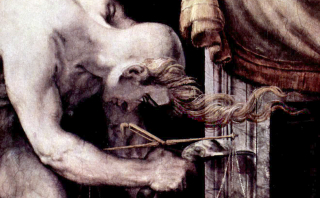
The “opportune moment” concept of kairos has been part of rhetoric since the time of Aristotle, who took the view that the moment in time in which an argument was delivered dictated the type of rhetorical devices that would be most effective. The sophists took a different view: Kairos is something to be manipulated by the presenter as part of adapting the audience’s interpretation of the current situation. Kairos assists in molding the persuasive message the speaker is communicating. Modern rhetoricians hold a middle view—that a presenter must be inventive and fluid because there can never be more than a contingent management of a present opportunity.
The Greek word kairos and its translation “opportune moment” embody two distinct concepts communicated through metaphors. The first concept, the derivation of the “right moment” half of the definition, is temporal. Greek mythology concentrated the spirit on the temporal. That is, the right time in the history of the world. For lawyers, that is important to know when making a policy argument. Is this the right moment in the trajectory of chronological time to make a particular policy argument. Will it persuade? Appellate attorneys who write civil rights and other impact-topic briefs will immediately understand what I am talking about. There is a right moment in history to make an argument. Some of the most important cases decided by the U.S. Supreme Court depended on the timing of the case—the kairos.
In an article about creating kairos at the Supreme Court, and published in the Journal of Appellate Practice and Process, Professor Linda Berger has written about the idea of kairos and suggests that temporal metaphors are still useful, because they help explain why today’s dissent in an opinion may become tomorrow’s majority decision. In her analysis, she demonstrates that what may look like a missed or lost opportunity to persuade may still have an impact. A snagged thread in the fabric of the law, which, at an opportune later time, can be pulled to unravel the existing fabric of the legal sky when the opportune moment comes around again.
But, the second half of the kairos definition—the opportunity—deals with the spatial. To seize the opportunity at the right time requires one to communicate in the right place and under the right circumstances. Rhetoricians commonly use visualizations of the penetrable openings needed for both the successful passage of the arrows of archery through loopholes in solid walls, and the productive shuttles of weaving through the warp yarns in fabric, as a way to describe the spatial aspect of kairos. Modern rhetoric takes these metaphors and elaborates, defining kairos as “a passing instant when an opening appears which must be driven through with force if success is to be achieved.”The idea is one of force and power.
For appellate attorneys, this represents the “where” an argument is placed in the internal whole of the document. The kairos of the legal writing. That depends, of course, on the overall narrative structure of the argument, the positions of emphasis in the beginnings and closings of sections and paragraphs, and the lasting imagery the writer wants the readers to walk away remembering. It is, as Professor Scott Fraley has noted in his Primer on Essential Classical Rhetoric for Practicing Attorneys, the idea that the writer understands the right moments “at which particular facts or arguments are inserted into the argument or presentation of the case.” He calls kairos, “the art of knowing when . . . to make the winning argument.” In other words, the strategic advocate spends time thinking about the persuasion of time.
———–
[1] Some of this entry relies on language I wrote in an article on a different topic. Ruth Anne Robbins, Three 3Ls, Kairos, and the Civil Right to Counsel in Domestic Violence Cases, 2015 Mich. L. Rev. 1359 (2015). For the background on Kairos and kairos, I rely on these works: Carolyn R. Miller, Kairos in the Rhetoric of Science, in A Rhetoric of Doing: Essays on Written Discourse in Honor of James L. Kinneavy 310, 312–13 (Stephen P. Witte, Neil Nakadate & Roger D. Cherry eds., 1992); James Kinneavy & Catherine Eskin, Kairos in Aristotle’s Rhetoric, 17 Written Comm. 432, 436–38 (2000); and Eric Charles White, Kaironomia: on the Will-to-Invent 13–15 (1987).
[2] Francesco Salviati, Kairos (1552-1554) (fresco); picture courtesy of Wikimedia Commons, https://commons.wikimedia.org/wiki/File%3AFrancesco_Salviati_005-contrast-detail.jpg
