
Seventh Circuit Benchslap II: Word Count Edition
So this one was more of a Judge-Easterbrook-wastes-no-teachable-moment moment than a true bench slap of the sort that Tessa discussed this week. But still.
Appellate practitioners in my region know well that the Seventh Circuit is a stickler on all-things-brief. It’s not so much that its rules are demanding; Circuit Rule 32, for example, actually imposes looser formatting and word-count rules than the FRAP defaults. But the circuit strictly enforces its rules. And it is quite opinionated about things that keep one’s brief from being a miserable slog to read. Like clean, modern typography. Section XIII of its Practitioner’s Handbook for Appeals (pdf) offers an excellent set of suggestions for making briefs more readable. The Handbook reflects a lot of knowledge and thought about the art and process of generating printed words on a page.1 Much of that material in the Handbook probably is the handiwork of Judge Frank Easterbrook. As one can see from section III of this piece, Judge Easterbrook (1) has thought a lot about how to generate attractive written work product and (2) knows his stuff about the technical ins and out of producing it.
Which brings up to today’s bench-slap-that-was-really-a-gentle-by-Easterbrookian-standards-bench-lesson. As Brad Heath of USA Today tweeted earlier today, Judge Easterbrook issued an opinion this morning that gave a pro-se litigant—and all of us, really—a lesson about the quirks of Microsoft Word and, like, words. As in word counts. And that lesson might help some of us avoid getting benchslapped for real.
The word-count issue came to Judge Easterbrook in his role as motions judge. An appellee sought permission to file a brief containing more words than permitted by circuit rules. Their justification: their pro-se opponent represented that his brief contained less than 14,000 words, but it actually blasted past the limit by more than 2,500 words. So Judge Easterbrook struck the appellant’s brief, ordered him to file a shorter one, and directed him to explain why he should not be sanctioned for falsely representing that his initial brief complied with the word limit. Here’s how the appellant responded:
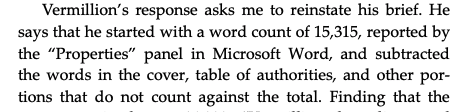
Seems reasonable, right? Who among us has not looked at the “Properties” panel to get our Word count?
Turns out that we’re doing Word wrong. Judge Easterbrook exposes the error of our ways:
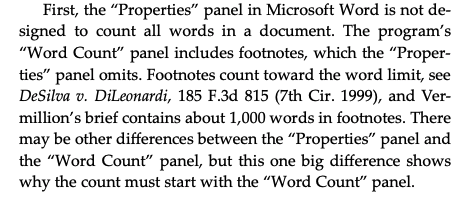
So word to the wise: don’t use the “Properties” panel to certify your word count. Especially if your brief has footnotes.
Things ended reasonably well for our Word-challenged pro-se appellant. There was no bench slap; just an order to go forth and be Word savvy and word-count compliant:
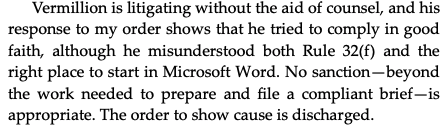
So, at certification time, remember: Word Count panel. Accept no substitutes.
1. For more, read Matthew Butterick’s Typography for Lawyers and Ruth-Ann Robbins’s classic “Painting with Print: Incorporating Concepts of Typographic and Layout Design into the Text of Legal Writing Documents.” ↩