Thinking slowly to address implicit bias
As advocates, we frequently represent clients who face potential bias from the jury box or bench. Sometimes the biases are explicit, but most often, the biases are implicit, and the person(s) holding our client’s fate in their hands may not even be aware of them.
William Blackstone, writing in the predawn of our American legal system, recognized the problem when he wrote of the danger that judges, “in spite of their own natural integrity, will have frequently an involuntary bias towards those of their own rank and dignity.” Blackstone, 3 Commentaries on the Laws of England 379 (1768). Cognitive science caught up with Blackstone’s common-sense pronouncements at the turn of this century, with a psychologist/lawyer named Jeffrey Rachlinski at Cornell Law School confirming that even trained jurists are susceptible to unconscious bias, and have difficulty in actually disregarding evidence that should legally be disregarded.
In Texas, where I primarily practice, there have been recent efforts to address these issues. In December 2016, the Supreme Court of Texas invited Dr. Rachlinski to speak at the Beyond the Bench: Law, Justice, and Communities Summit. He reiterated his research suggesting that our intuition is often influenced by unconscious biases, and that these biases also influence trained judicial decision makers. Since that time, the discussion has continued, and there are initiatives to help both judges and potential jurors identify and address those potential biases.
How do we, as lawyers, help our clients ensure that these biases are not going to harm their case? First, we have to understand those biases. I highly recommend the writings of Dr. Rachlinski, as well as the very accessible book “Thinking, Fast and Slow,” by Daniel Kahneman. Kahneman, in particular, has a talent for pointing out just how many mistakes we make when we allow our “fast” system of thinking (necessary to so many daily, repetitive tasks) to handle the analysis, and the need to trigger a “slow” analysis to avoid those errors.
Second, we need to make sure that we, as well as our judges, employ a deliberate factual and legal analysis that engages the more analytical part of our brains rather than permit a simple surface analysis of what a “reasonable juror” might decide. This is particularly true in a world where the member of one political party tends to believe anyone associated with the other political party is incapable of reasonableness.
By understanding the potential biases at play, we can address them and try to prevent them from having a negative impact on our client by drawing them into the light of reason. And by explicitly requiring a system of inquiry that depends on a direct analysis of facts or legal factors before any conclusions can be reached about what is “reasonable,” we can try to guide our judges past their unconscious biases and into a more analytical, unbiased frame of mind. We can also support efforts, like the 2016 Summit in Texas, as they educate our judges about their own biases.
In the meantime, be aware of these biases in both your judge and yourself. While we are advocates for our clients, that advocacy can only improve if we use this research to help us eliminate blindspots we ourselves might have because of our own biases.
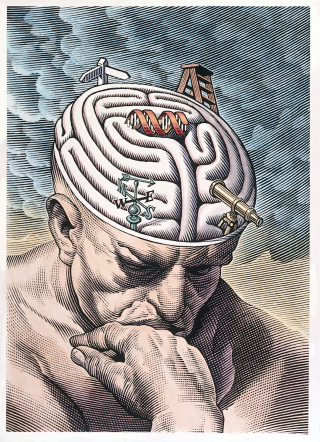
(An earlier version of this article appeared on LinkedIn. Photo attribute: Bill Sanderson, 1997. Credit: Wellcome Collection. CC BY 4.0)