
Three Lessons from a Viral Oral Argument
Oral arguments rarely make the news. Normally, the advocates and the court are staid and respectful, the issues are esoteric, and the only discussion following is from law wonks and Appellate Twitter members discussing the finer points of the argument and reading tea leaves. But occasionally, something so extraordinary happens that the oral argument catches the attention of a much wider audience.
Last week, an oral argument went viral after an advocate was removed from the courtroom following a very truncated oral argument. Lawyers, law students, and even those not involved in the law are talking about the event. So while people are thinking about oral arguments, I thought it would be good to learn a few lessons from what happened.
1. Respect the Tribunal, Even if you Disagree.
The easiest lesson to draw from the argument is that respect for the court must be shown at all times, even (and especially) when you are frustrated. Oral argument can be a very tense experience, with rapid-fire questions from a seemingly hostile bench. The presenter, however, cannot be equally hostile.
This seems unfair. After all, most of us argue that an oral argument should be more like a conversation than a presentation, and in a conversation, if someone fires at you, you fire back. But this is not a conversation between equals. This is a conversation between advocates and a tribunal. The tribunal gets the last word on our client’s fate, and we, as attorneys, have obligations to help uphold public trust in that tribunal, whether we agree with its rulings or not.
Thus, when we disagree with a tribunal, we have to make every effort to disagree with the tribunals’ reasoning, not with them personally. And when the advocate in the video seemingly implied that the judge had not “done his homework” by reading the briefing, the panel believed he did just that.
2. Do Not Assume that Questions Show the Panel Has Made Up Its Mind.
Another lesson to draw is that we should not be quick to assume that a given question means that a panel has either made up its mind, or that it has not read our briefing. Questions can come from a variety of motivations. They can signal that the Court does not know the answer, as the advocate here assumes. But they can also be a way for the panel to test the strength of an argument, or even as a way for the judges to open up a discussion they have already had behind closed doors.
Whatever the motivation behind a question might be, we need to see questions as opportunities. If the Court actually does not know an answer, we have not communicated that point well enough, and the Court is giving us an opportunity to explain it. If the Court is asking the question to test the strength of our argument, we need to demonstrate that strength. If the questioner is trying to flag a discussion with another panelist, then you now have an opportunity to advocate for your client in that discussion. These are all good things, and we need to keep that mindset in place even when being hard pressed.
3. Know When to Keep Quiet.
After the Appellant in the recording had his exchange with the Justice and had been told to sit down, I couldn’t help but keep muttering “stay quiet, stay quiet!” to myself as the Appellee approached the podium. The best thing that the Appellee could do was what he did – stand up, introduce himself, and say that he had nothing to add.
It is difficult to scrap your written outline and preparation, but there are times when that is the best move. When an Appellant has had a bad exchange with the panel, and the panel seems to have made up its mind (but be wary of lesson 2!) it may be best for that exchange to be the last thing the panel hears.
Oral argument is designed to raise issues not addressed in the briefing. If the advocate had stood up and tried to justify his client’s position after that exchange, he risked doing just that. By staying quiet, he avoided that potential.
He also negated any need for a rebuttal. Although the panel said that the Appellant had “waived” his right to rebuttal by his comments, there really was no need for a rebuttal, because the Appellee had given nothing to rebut. This silence may also be useful when an Appellant appears to have withheld a point in order to make it more strongly in a rebuttal. If you don’t address anything that can be rebutted, you can take away that opportunity to have a scripted “parting shot” in rebuttal.
Arguments like this one are, thankfully, rare. Hopefully, by learning from them when they arise, we can keep them that way.
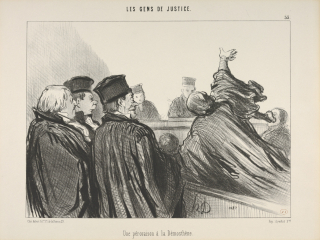
(image credit: Honore Daumier, “Une peroraison a la Demosthene,” plate 33 from Les Gens de Justice, November 1, 1847)